
Reviewing Scotland’s Curriculum: Expressive Arts
“…role of knowledge fragmented”; “…absence of clarification on what is expected in terms of knowledge”; “…place given to knowledge is too implicit”; “Broad General Education (BGE) curricular in both primary and secondary could still benefit from a clearer definition of the role of knowledge in learning”; “..the role of knowledge should be made more explicit in CfE.”
These were some of the findings from the Organisation for Economic Co-operation and Development’s (OECD) report: Scotland’s Curriculum for Excellence: Into the Future, published in 2021 which became the catalyst for the Scottish Government to charge us at Education Scotland to review each of the curricula areas within Scotland’s Curriculum for Excellence (CfE)
As a result, on a rather windy and wet Wednesday at the end of January over 150 ELC, primary, secondary teachers along with representatives from Initial Teacher Education, Further Education, SQA and industry leaders congregated in Stirling Court Hotel to review the aforementioned statements within the context of the Expressive Arts. Having that spread of experience was important as the notion of demystifying the interface between what happens in schools, further and higher education and industry is something that has been the cornerstone of my own pedagogy both as a teacher and a senior leader because not only do the pupils benefit from an enhanced and dynamic experience of the curriculum, but also staff benefit by accessing professional learning and support to develop their own practice. Moreover, since taking up my post at Education Scotland I have been keen to ensure that our national arts organisations along with other external agencies understand the complexity of our education system, notably clarifying the barriers around language such as closing the poverty-related attainment gap, ACEL data, SAC, literacy, numeracy and other key tenets that permeate school and local authority improvement plans.
During the morning session, we set out the objective of the day as well as highlights from the OECD report. After giving an overview of the purpose of the Expressive Arts within Scotland’s curriculum, the delegates were tasked about thinking how the broad principles and purpose of the Expressive Arts permeates the four capacities of CfE. This is easy to do from a subject-specific lens, but when tasked with a more general approach to this though the principles of ‘Creating’, ‘Presenting’ and ‘Evaluating’ and how that exemplifies Successful Learners, Confident Individuals, Responsible Citizens and Effective Contributors can be slightly more challenging. However, the delegates rose to that challenge and shared their findings drawing on the vast range of experience in the room which was both insightful and enlightening. What is interesting, particularly in the primary sector, is the idea that teachers need be able to draw or dance or act or play an instrument to create expressive arts for their pupils, yet those same teachers will happily admit that they don’t need to write a book to teach literacy. It is the perceived skill set of the expressive arts that can become a barrier, yet applying the same pedagogical practice along with teaching and learning scaffolding for pupils in the same way one would deliver literacy and numeracy might enable to build both confidence and capacity for the successful delivery of the arts. The popularity of Education Scotland’s ‘Numeracy in Expressive Arts’ is an example of the desire of teachers to engage with this area of the curriculum: Numeracy in Expressive Arts (education.gov.scot)
In the afternoon session, there were breakout rooms for delegates to engage with their curricula area within Expressive Arts (Art and Design, Dance, Drama and Music) to consider what how the design of CfE can better help learners consolidate a common base of knowledge, skills and attitudes by the end of BGE, and nurture and hone this base for them to progress seamlessly through Senior Phase and the choices offered. (OECD, 2021) Within that, we specifically asked:
What knowledge, skills and attributes would a learner require within the
- Art and Design
- Dance
- Drama
- Music
curriculum to thrive and flourish now and in the future?
The intriguing aspect of the Expressive Arts in Scotland, and globally, is that many people feel each subject area are natural bedfellows; however, I have never shared that view. These subject disciplines are uniquely different, both in knowledge and skillset, and, consequently, attract a wide range of learner from the introvert to the extrovert and everything in between. A learner may be very comfortable in an Art and Design classroom, but may have a natural fear of being in the Drama studio, for example, and the same applies to the teachers of these subjects too: Music teachers may not be comfortable delivering aspects of the Dance curriculum. I don’t know if that is necessarily the case for the other subject areas within Scotland’s curriculum…
One of the interesting findings from the day was, despite being tasked at looking at the position of knowledge within each subject, teachers returned to the development of skills and how important the expressive arts plays in this. Yes, there was an acknowledgement that there would need to be a baseline of knowledge taught, but that was to unlock further the skills needed to develop in each subject as well as supporting the development of the whole person: something very close to each delegate as the purpose of why we teach these subjects. Indeed paradoxically, it would appear that the OECD also is keen to accentuate the meta skills that children and young people develop for those undertaking the expressive arts in school. The tables below come from the OECD ‘Art for Art’s Sake’ report published in 2013:
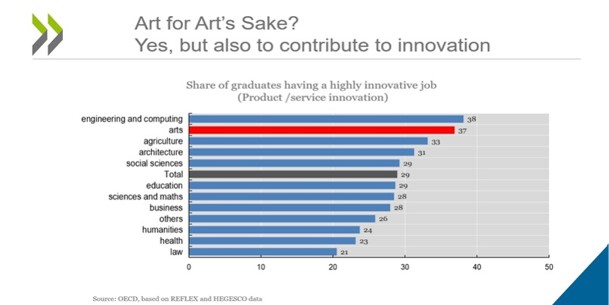
The above table illustrates the OECD’s findings of the 100 most innovative jobs in OECD economies, they asked where those graduates come from. Of course, you would expect engineering and computing to top the list as innovation today is about technological innovation, but in second place were those graduates that had studied the arts. Why is that? Well, the table below, again from the OECD, gives a clear indication of this:

These meta skills are key to success here – the ability to effectively share ideas and express opinions along with others as highlighted above are key attributes that learners need to be successful in innovative careers.
Two key themes emerged from the day. The first one was a consensus that we need to move away from Experiences and Outcomes as well as Benchmarks in favour for a new technical framework that addresses both knowledge and skills. The idea of a ‘Know-Do-Understand’ approach which would enable to create that baseline of knowledge but learners using that knowledge to manifest in practical skill to confidently grasp the understanding of what they have been taught seemed to carry favour with the delegates. Similarly, many of the delegates returned to a slide that was shared in the morning session: the Excellence and Equity tracks:

Now these tracks of course cross over as the slide highlights; however, on the Excellence track are a small number of learners who have a clear aptitude and talent for an area of the expressive arts and the curriculum should support their development of knowledge and skills to a purposeful position for them to either go into the arts industry or access high quality degree programmes at either elite (and nothing wrong with being elite, just elitist as discussed during the day too!) Conservatoires and/or Universities in the UK or internationally. The Equity track is where the vast majority of our learners will be on, and for them it is important, through the curriculum, to not only develop the skills as already highlighted, but also if they have had an enjoyable, stimulating successful arts education will become advocates for the arts when they take their place as adults in society. They will become the audience members for the theatres, art galleries, concert halls and. moreover, as parents may support their own children to engage with the expressive arts within the curriculum in whatever shape that curriculum takes in the future.